Monday, October 1, 2012

Pulps, in Hardcover

     If there is one thing I have always found interesting about the widespread, public perception of pulp magazines, it is the idea that they were all drivel, written for half-literate readers, and something far apart from hardcover books and more “respectable” tomes of the day. While even the most cursory glance through letter columns, or the acknowledgement that some of the brightest literary minds of the twentieth century either read, or wrote for, the pulps, quickly dispels such elitist (and to some degree, academic) nonsense, the idea still persists.


     A third fact proves such a view nonsensical; the fact that many pulp stories were actually printed as hardcover novels and collections. Over time, and through frequent trips to flea markets and antique malls, I have come across a number of such reprintings. Living in Richmond, and really the surrounding Central Virginia area as a whole, has been a boon in this regard; all of these books, and countless more books, pulps, comics and story papers have been found in the general Richmond area, and there are still dozens of outlets that I have yet to explore. 

     And now: images and information relating to a few of my favorites from my, admittedly small, collection of pulp hardcovers.

PhotobucketDo and Dare
Alger, Jr., Horatio. Do and Dare; Or, a Brave Boy’s Fight for Fortune. New York: Hurst & Company, 1900.
  
     Do and Dare is a boy’s adventure story by Horatio Alger, Jr; it also happens to be the first story ever printed in The Argosy. Do and Dare was among the handful of manuscripts Frank Andrew Munsey carried with him from Augusta, Maine to New York City, leaving his job as a telegraph operator behind to pursue his dreams of striking it rich at the printing press. Given Alger's reputation at the time, Do and Dare was undoubtedly the most valuable manuscript Munsey brought with him, as evidenced by its use in the inaugural issue of his Golden Argosy (December 9, 1882), and as the cover story, no less.


Photobucket
The Moon Terror, and Other Stories

Birch, A. G., Anthony M. Rud, Vincent Starrett and Farnsworth Wright. The Moon Terror, and Other Stories. Indianapolis: Popular Fiction Publishing Co., 1927.

Farnsworth Wright, editor of Weird Tales and later Oriental Stories, also edited this collection of stories that originally appeared in Weird Tales; A. G. Birch's "The Moon Terror" was first serialized in the third and fourth issues of Weird Tales, while Anthony M. Rud's "Ooze" appeared in, and graced the cover of, Weird Tales' inaugural issue in March, 1923. The other two stories, "Penelope" by Vincent Starrett, and "An Adventure in the Fourth Dimension" by Farnsworth Wright appeared in Vol. 2, No. 3 and  Vol. 1, No. 3, respectively. This book is of particular interest to me, aside from its place in weird fiction history, due to it's title story: "The Moon Terror" is a fantastic example of the type of yellow peril stories that appeared in Weird Tales, and scores of other pulps - something I have written about quite extensively.


Photobucket Della-Wu – Chinese Courtesan

Owen, Frank. Della-Wu – Chinese Courtesan, and Other Oriental Love Tales. New York: The Lantern Press, 1931.
Second Printing

     The title story of this anthology, "Della-Wu - Chinese Courtesan," is a tale I mention in my book, Anti-Foreign Imagery in American Pulps and Comics, 1920-1960; as opposed to most of the narratives I discuss, "Della-Wu" is one of the few from the time period that, in my mind, paints a rather favorable picture of "the East" and it's inhabitants. The story of a young courtesan, too proud to live her life under others' orders, I found it to contain a strong, female Chinese lead, at a time when most stories occurring in China featured the expected stereotypes; the sneaky, conniving, half-human coolie or Mandarin. The fact that such a  strong disposition is granted, not only to an Asian, but to an Asian woman no less, is telling, as such characters were usually depicted as "demure butterflies," waiting to be rescued by strapping, Anglo-Saxon males. "Della-Wu - Chinese Courtesan" appeared, in pulp form, in Oriental Stories, Feb-Mar., 1931.


PhotobucketPhotobucket  
The Foundation Series
Asimov, Isaac. Second Foundation. New York: Gnome Press, Inc., 1953. First Printing.

     "The Foundation Series" first appeared in the May, 1942 issue of Astounding; the stories that appear in this volume were first printed in magazine form in the late 40s and early 50s. Having been a fan of Asimov's for years, thanks to my father's encouragement in my youth that I pick up the classics of SF (which included Clarke, Herbert and Asimov), finding an early printing of some of my favorite Asimov stories was fantastic in and of itself; finding a first edition, with dust-jacket included, was even better. Definitely one of my better flea market finds, I have to admit.


Monday, August 27, 2012

Pulpfest 2012


Pulpfest 2012, August 9 – August 12, 2012 – Columbus, Ohio

            I had been looking forward to Pulpfest for quite some time, and had made my reservations, both for the hotel and air travel, well in advance. Having heard of the voluminous amounts of pulp magazines that were (likely) to be found in the Dealer’s Room, I began saving my discretionary money in advance.
            A night out with friends the previous evening prevented me from getting any last-minute preparations accomplished that Wednesday night, so I caught my 7:00 AM flight out of Richmond Thursday morning on no sleep, powered only by green tea. Following a short layover in Newark, I reached Columbus around 2 or so in the afternoon, making my way to the Hyatt Regency. I had attended several other conventions that were housed in the chain’s Regency line of hotels, and all were very impressive, and the Hyatt Regency Columbus was no exception. Very nicely laid out and spacious, with convenient access to a variety of eateries, the hotel’s only major flaw, in my mind, was that the information they had regarding the location of particular rooms could be improved upon, just a tad.

Photobucket
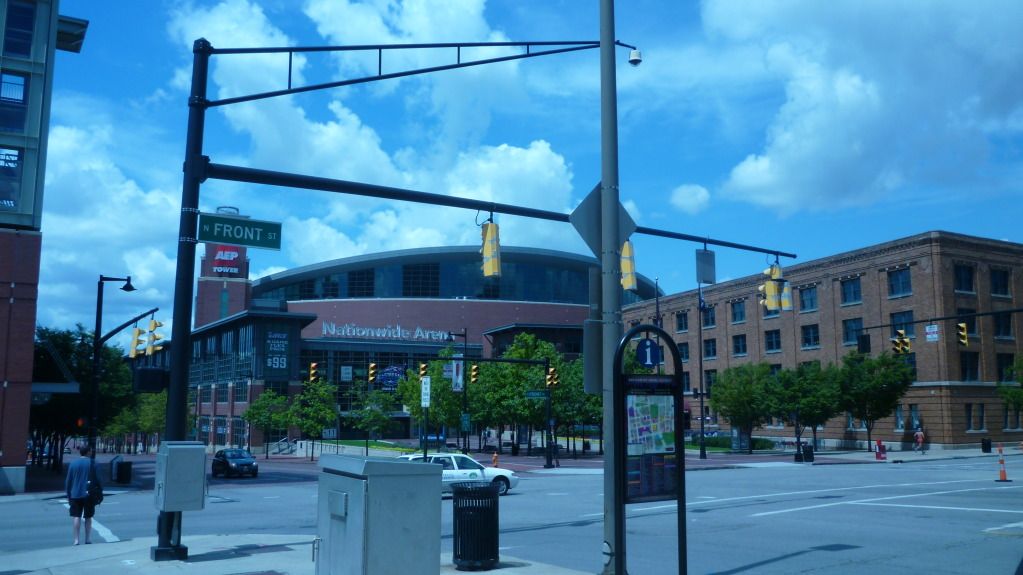
The Arena, just a block or two down from the hotel. For some reason, the thumbnails are ridiculously blurry; the actual, linked images are of far superior quality.
            As early registration was still a few hours away, I decided to look about the general area surrounding the Hyatt and conference center for a bit. The Arena was a block or two down the main drag, and housed a good number of restaurants and other attractions; the North Market, a large eatery/bazaar two blocks west of the hotel was an attraction, in and of itself.

Photobucket
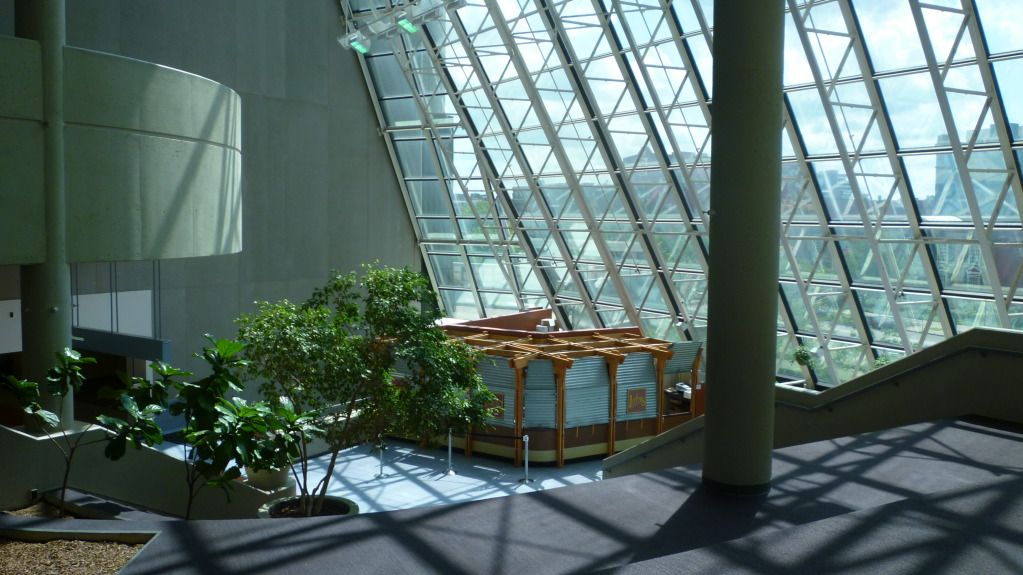
The Atrium on the second floor, just below the Dealer's Room.

            After wandering around a bit, I returned to the hotel, and, due to a lack of rest the previous two days, fell asleep for the next few hours. Unfortunately, I missed both a panel hosted by Ed Hulse and Garyn Roberts concerning Campbell’s tenure at Astounding Stories, as well my chance to register. I awoke 15 minutes before early registration ended, but I could not find where registration actually was (the hotel staff insisted that it was on the second floor), so I went back to the room after exploring the hotel and conference center a bit more, and called it a night after reading for a little while.
            The next morning (Friday) I woke up in time to get to registration by 10; it was on the third floor, in the Dealer’s Room. While my inability to find it the night prior may strike some as odd (or idiotic), it does not surprise me much. Outside of MarsCon in Roanoke, Virginia, Pulpfest is the smallest convention – in as far as the number of attendees – that I have ever been to; every other convention in my recollection had a separate registration area, away from most of the panels and Dealer Room(s) and whatnot, so that is what I was looking for. As sad as it may sound, it never occurred to me to look in the Dealer’s Room for the registration table. Regardless, I acquired my registration badge and packet (there was someone else’s badge in my bag as well – a Gilbert someone or another; I handed that over to the young woman at the table, as I figured Gilbert would appreciate that). With that in hand, I began looking about the Dealer’s Room; the ballroom chosen for the spot was quite spacious and provided ample room for moving about, unlike some shows I have been to, where being packed in like sardines seems the norm. There was a large variety of items to be had: pulp magazines, of course, in addition to rare and antique books, classic (and obscure) film and serial dvds, some comic books here and there, and collections of various fanzines, at differing tables.


Photobucket
Stairs from the second floor, to the third, which housed the Dealer's Room.
            Still being rather new to the entire “pulp scene,” I did not have a very long want-list; rather, I had an idea of the type of things I was looking for, and out of those a few issues in particular. I was hoping to find anything written by Frank Munsey that I wasn’t aware of previously, as well as any collected printings of his stories that had originally appeared In The Golden Argosy’s early years. I also hoped to find any issues of Munsey’s containing editorials by the publisher regarding Theodore Roosevelt’s independent candidacy for President, of which Munsey was an ardent supporter. Per my interest in Chinese history and its portrayals in the pulps, I was on the look-out for any “yellow peril” titles I happen to come across. As far as particular authors, I only had a few that I kept an eye out for;   a few alumnus of Weird Tales and Astounding, and, in particular, a five part serialization that ran in Argosy All-Story Weekly, beginning in December of 1926 – Auguste Villiers de L’Isle-Adam’s  The Future Eve, an 1886 speculative fiction tale that coined, what later became, the word “android.” I have an original, complete (translated from the original French) edition, but was hoping to find this later serialization; the cover of the issue which carried the first installment is is a fantastic piece of pulp/SF art history, in and of itself. I was also hoping to complete my collection of Marvel Science Stories/Tales/Stories – I have the first 4 issues, but would (like any good collector) prefer to have the whole set. I was also on the look out for several issues and stories from various titles that I had read only on microfilm recently during research, but enjoyed to the extent that I wanted to have the actual issues, in hand. So, my list was modest; a great deal less ambitious and comprehensive than most of my fellow attendees, to be sure.
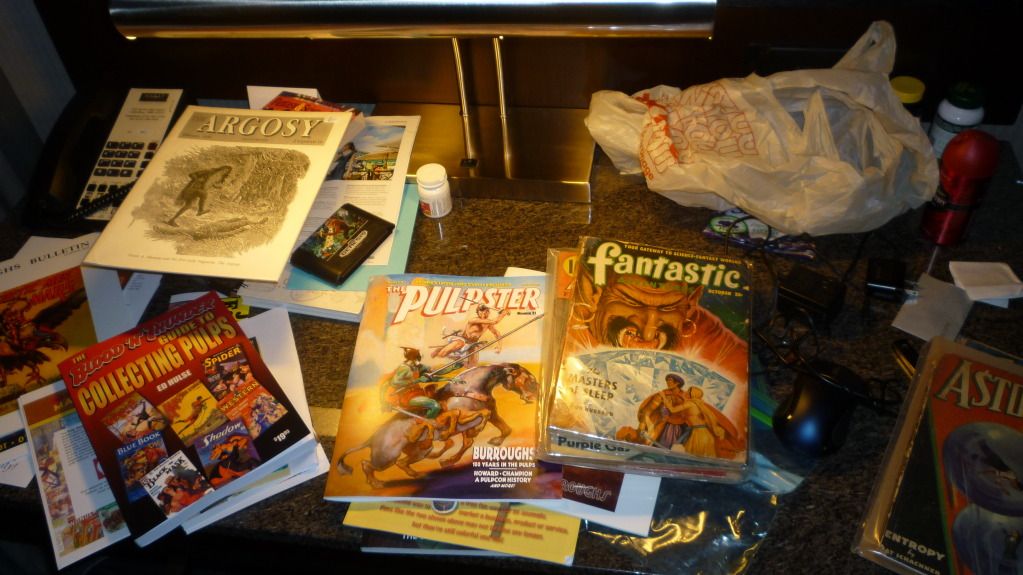
            I picked up a few things that Friday  – some issues of Argosy starring Wort’s Peter the Brazen, and a Fantastic Adventures containing “The Masters of Sleep” by L. Ron Hubbard. As with comic books, I like picking up titles that look interesting, but that I have never heard of or ones I know did not last very long, so I picked up the first issue (March, 1941) of Cosmic Stories. Coming full circle to the front of the Dealer’s Room, I came across the Murania Press table; I saw that Ed Hulse, pulp historian and editor of Blood’n’Thunder was there, and decided to try and speak with him, having only shared email correspondences, thus far. At his table, I also came across an earlier issue of the fanzine Pulpdom (#5, I believe), one that was almost entirely focused on Frank Munsey; I snatched that up. Ed saw my name tag, and reached out his hand in greeting; I quickly found out that the two gentlemen he was conversing with were also members of the PulpMags mailing list; Walker Martin and Lohr McKinstry. It was great to finally meet those with whom I have spoken with only through email, and had heard a great deal about (one thing I quickly learned about Pulpfest – it is, if nothing else, a place to hear great stories of pulp fandom’s past). All three were great to speak with, and I enjoyed the short conversation immensely. Walker asked me what was going on with Argonotes, and I had to admit, for lack of a better excuse, I simply had not had the time, between work and several writing projects, to devote myself as much as I would like to it; I am glad he mentioned it, however, because it inspired me to get back on it, and that is exactly what I did following our conversation – after a small snack break at an eatery in the convention center, during which I poured over the contents of The Pulpster, I went over to the Starbucks adjacent to the Arena and entered my first Argonotes post in almost a year. It was little more than an update, an apology, and a dedication to return to the blog, but it still felt pretty good to be working on it again.
            Friday evening there were two panels that I was determined to attend (I got back from Starbucks too late to catch but the very end of the official welcome panel). At 7, FarmerCon VII hosted Lord Tyger, Time’s Last Gift, and the Gods of Opar. It examined the works of science fiction author Philip José Farmer, a writer who, I am sad to say, I had no prior knowledge of before Pulpfest. The panel was extremely interesting, not only because it provided background information concerning the author’s works that piqued my interest enough to purchase a few of his works in the Dealer’s Room later; the panelists, Win Scott Eckert and Christopher Paul Carey (with moderator Paul Spiteri) spoke at length regarding legacy works (based on Farmer’s input and notes regarding unfinished stories), and personal stories about the man himself. Eckert, in my opinion, gave more information about the worlds and timelines Farmer created, whereas Carey introduced any newcomers to the man himself, his family and his habits. Together, the two presented a fantastic panel that, as I said earlier, only raised my interest in Farmer’s work.
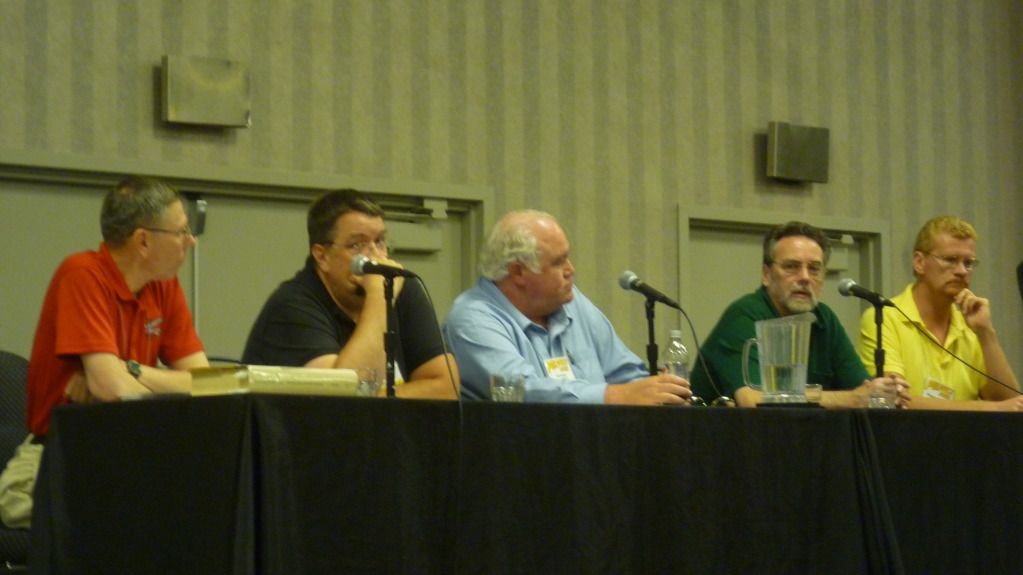
            From panel’s end to 9:00 PM, I grabbed the first real meal I had eaten that day at the lounge/bar on the hotel’s second floor. Over my “Tots Ranchero” and Jagermeister/Coca-Cola, I took some notes on the previous panel, and my thoughts on Pulpfest thus far, before heading back for the next presentation. At 9, Barsoom and Beyond, the focus of which was the evolution of Mars’ depiction in pulp and popular literature, beginning with Edgar Rice Burroughs, was expertly moderated by Ed Hulse, and featured an impressive roster of panelists. Henry Franke, current treasurer of the Burroughs Bibliophiles, was the resident Burroughs expert, and Garyn Roberts was able to share Ray Bradbury’s personal insights into Mars and Burroughs, thanks to the personal friendship he held with the author for many years; novelist and pulp authority Will Murray spoke on the stories of Otis Adelbert Kline, and Steve Haffner, who has edited a number of recent reprints of her works, described Mars as it appears in the stories of SF author Leigh Brackett.


Photobucket
The panel, "Barsoom and Beyond."
            I have been a longtime fan (at least, by my reckoning of years) of Burroughs and Bradbury, and I had become familiar with Leigh Brackett’s stories while working on my thesis. However, Kline’s writings I was only vaguely familiar with; so, I was able to gather new insight into authors I already admired, while also gaining an introduction to another whose place in pulp and SF history I now understand a great deal better. Roberts’ insight into Bradbury was particularly helpful, thanks to his closeness to the author; it’s a personal insight that others could not have provided, and it was a valuable contribution to the overall discussion.
            That is something that I will make note of here, something that I noticed about Pulpfest, when compared to other conventions. With the exception of some smaller shows (I mention MarsCon again), I hate to admit that in the case of many conventions I have attended, the panelists were not a great deal more knowledgeable about their subject matter than a majority of the attendees. I come to Pulpfest after about a decade and a half (am I actually old enough to have done anything for over 15 years? Good Lord) of attending comic, anime, and SF conventions. I have attended comic convention panels where the speakers were constantly getting dates, facts, creators and characters confused, or outright wrong; I have attended anime conventions where the panelists conducting presentations regarding Japanese or Chinese live-action cinema were, to put it nicely, barely literate concerning the history of the mediums. As fandoms have come to accept more and more individuals who are not necessarily fans in the traditional sense, but rather gravitate to topics of popular culture in order to form some sort of identity for themselves, such instances are becoming more and more common. Very few, if any at all, (younger) attendees of a modern SF convention have any idea who Hugo Gernsback or John W. Campbell are, and that’s mainly due to the fact that, for the modern fan, the social reasons for belonging to a group, simply for the sake of belonging, matter more than any sort of depth of personal interest.
            This, however, is not true regarding Pulpfest, as far as I could tell. The sub-culture is still small enough so that it is almost entirely composed of actual fans. While I believe that is a good thing, it does raise questions concerning the future of the pulp community; but, that is something I will address in another post, perhaps.
            That was the end of Friday for me; I intended to go back down for a panel that began at 11, but some family situations back home were brought to my attention, and I was needed on the phone well past 11. After reading for a bit I headed off to sleep. Saturday morning I woke up, headed down to the third floor, and scoured the Dealer’s Room for a bit, speaking to Mr. Hulse a bit more and picking up a copy of his Blood’n’Thunder Guide to Collecting Pulps (which I asked him to sign, of course). After picking up a few additional items, I explored the area outside of the hotel for a few hours, this time to what seemed to be the more historic parts of the city, before heading back just in time to catch the two panels I wanted to see that evening. Both focused on the creations of Robert E. Howard; the first, featuring Mark Schultz and Jim and Ruth Keegan, covered the many artists and stylistic licenses that have been taken over the years in bringing Howard’s Conan to life, while the second, with Rusty Burke, Don Herron, Brian Leno and John D. Squires, spoke more to the man behind the barbarian: Howard himself. Unfortunately, this second Howard panel was cut short; the first had gone on a bit longer than planned, so the second was trimmed down from an hour to 30 minutes to make room for the auction, scheduled at 9:30 PM. Why the auction was not simply pushed back, and the second Howard panel allowed its full hour is something I do not understand, and constitutes my one, real compliant concerning Pulpfest.

            Now, I am not beyond admitting my newness to the pulp scene, and I did get the general impression that the auction was just as much a time-honored tradition as the idea of a pulp convention itself, so perhaps I am alone in my opinion that a panel outweighs an auction. In any event, I attended the auction for most of its duration; it was a learning experience in several ways. I had never been to an auction, or at least not one like this; other conventions have had fan-art auctions and the like, but never estate collections or anything spanning back several decades. Second, it introduced me to several pieces of pulp history I was not aware of, such as PEAPS (Pulp Era Amateur Press Society) publications and other works that I took note of as being valuable works for future reference. The highest bid was well over $1000 for a complete run of the PEAPS series of mailings, and the second highest was around $900 for a painted reproduction of the cover to the first issue of The Phantom Detective – to be honest, this surprised me, as all the talk I had heard about the auction beforehand led me to believe that these bid levels would be amongst the lowest of offers, when in all actuality it seemed that the average price paid seemed to be around $100 or so, if not usually lower.
            I left the auction around midnight or so, as there was only one table of items or so left, and, from what I had seen, they didn’t seem as interesting as the varied items that had come before; besides, the days without sleep earlier in the week were still taking their toll, so I headed off to my room, watching an episode of Mystery Science Theater 3000 I had on my computer before dozing off for the night.


Photobucket
My hotel desk, Saturday night.
            Sunday was the end of Pulpfest, but still rather busy for me, as I had a number of flights, layovers, and more flights and more layovers ahead of me for most of the day. Mr. Hulse had invited me to a breakfast he and a number of his friends were having Sunday morning, but my phone’s alarm did not seem to rouse me in time, so I missed it – something I still regret, as I’m sure I would have heard a good many more stories of pulpish history. I did not wake until around 9:30 AM or so that morning; I packed up all of my belongings and purchases, and set them aside until I was ready to check out. I headed back down to the third floor for the Dealer’s Room, to see what was to be had this final day, and also to apologize to Mr. Hulse for not making it to breakfast; he assured me there was no need to apologize, and actually inquired if I would be interested in writing a report of Pulpfest 2012 for the next issue of Blood’n’Thunder, from the perspective of a “newcomer.”
            I purchased a few more last minute items, mostly a few yellow-peril themed Argosys, and a black-and-white reprint of the first issue of Dr. Yen-Sin, before taking my leave of Pulpfest; I never did find the one issue I was looking for the most, the first installment of “The Future Eve” (Argosy All-Story Weekly – December 18, 1926). I gathered my things, and checked out at the front desk; as I still had about an hour until the shuttle from the airport arrived, I checked my luggage with the hotel and explored the nearby North Market a bit more, before returning, boarding the shuttle, and heading back to the airport and, after some time spent at both the Columbus and Atlanta, Georgia airports, home to the Old Dominion.

     I enjoyed Pulpfest, both as a convention, and as a learning experience on a number of levels. In a follow-up post, I will include some thoughts that have come across my mind in my capacity as probably one of, if not the, youngest attendee at this year's gathering.

Sunday, August 12, 2012

Report coming soon...

     I am about an hour away from flying out of Columbus, and back to the Old Dominion; however, I just wanted to post and say that my plans for a report have changed, to some degree. Mr. Ed Hulse, editor of Blood 'n' Thunder, has asked me if I would like to contribute a Pulpfest 2012 convention report to the Fall 2012 issue of his journal - the very same type of report I was planning on posting here.

     My intention hasn't changed, really. Argonotes will still host a small report on my part, but I will leave more of my thoughts about being a relative newcomer to the pulp scene to the printed report - think of what will come here as a preview, along with the few personal photographs I took along the way. I hope those who read my posts will check out both versions.

     I am also intending to finish a number of posts I started almost a year ago, continuing a history of the Argosy, but which I never quite got around to posting and finishing; the intervening time has allowed me to gather a great deal more primary sources, so I will be expanding, and finally posting those, as well.

     As always, thank you very much for reading, and I will certainly be posting again soon.

Friday, August 10, 2012

It has certainly been a while.

     As the title suggests, it sure has been a long time since I have posted anything here, which was not intentional on my part, but rather as more work and projects began, I have had less and less time to devote to Argonotes, unfortunately. This however is going to change.

     I am currently at Pulpfest 2012, in Columbus, Ohio, and after a conversation with a friend I had only spoken to through emails up to that point (who, as of this writing, still owes me a beer, Mr. Martin), as well as the fact that another story-paper researcher has contacted me after viewing this page (thank you again, Mr. Walther - I will be getting back to you soon, you have my word), I have decided to do everything I can to return to this, which was really my first foray into popular literature writing and historiography, outside of academia.

     I have been rather busy during this absence from Argonotes. My master's thesis is being published as a book by McFarland later this year.

Anti-Foreign Imagery in American Pulps and Comic Books, 1920-1960

     I have  contributed a few more articles to the Pulp Magazine Project, and am currently working on an article regarding Gender and Race in the Pulps. I am also writing several entries in an upcoming encyclopedic work for Greenwood Press-ABC/CLIO, Comics Through Time: A History of Idols, Icons, and Ideas. These projects, as well as my job and my researching possible PhD programs, have all added to a lull (if that even describes such a long period) in attention paid to Argonotes.

     My first, new posts will consist of panel reports, as well as my own view of  it from the perspective of a relative "newbie" (in terms of age; time spent in research; and years of interest), regarding Pulpfest 2012. Hopefully, I will have the first entry and photos up later this evening.

     I would like to thank all of those who have followed this in the past, and are still checking back; as I said, it has been awhile, but I am hoping to make up for lost time in the near future.

Wednesday, October 19, 2011

Frank Munsey Archives

     There has been a significant gap in posts on my part, I can admit, due mainly to a number of issues beyond my control; although, I always intended for this to be a source of information, as opposed to a constantly updated blog in the more common manner, so a gap in posts is alright, I suppose.

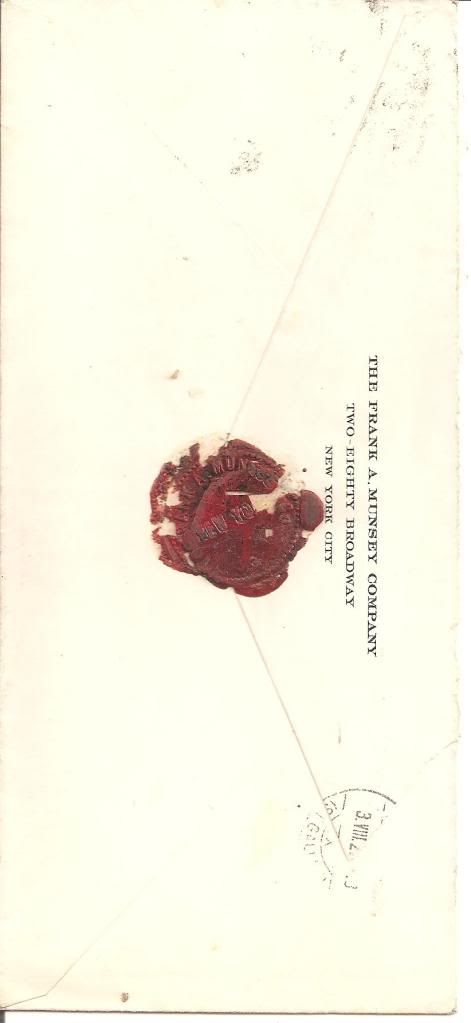
     I have been writing a few pulp histories for the Pulp Magazines Project (Argosy and Wonder Stories, in particular), and have been finishing thesis revisions. Recently, I have acquired an immense archive of original, primary source documents relating to the last years of Frank Andrew Munsey's life. I have been combing through these the last month or so, and wanted to post a few on here - I am hoping to expand my biography of Munsey that recently appeared in Blood 'n' Thunder into a larger, more comprehensive work. A few small things at the moment; a letterhead from the Munsey company, a telegraph transcription announcing his death, the cover of a remembrance written by a friend, and other items, with more detailed records appearing in future posts, after I have had adequate time to sort through everything.

     Among various letters, transcripts of Munsey's X-ray examinations, and newspaper articles chronicling his health, the items I am most excited about are the three (so far) remembrances concerning Mr. Munsey that are in the archive, all of which I know have never been cited before in any biographical work. These will prove invaluable, not only as primary sources as required by any good biography, but also in the furthering of a point I tried to make in my Blood 'n' Thunder piece; that Munsey was not the horrible, hated monster that he has been portrayed as, almost since the day of his death. The Ebenezer Scrooge-like persona that has filtered down through the decades is one that is unwarranted; primary sources such as those contained in this archive, and others, contradict such an interpretation of the man's life.

     Again, what follows is a short sampling of the archive, and I intend to post more substantive items as I go through all of the file's contents. As always, thank you for stopping by!

Photobucket
Photobucket
Photobucket
Photobucket
Photobucket

Wednesday, September 7, 2011

Dime Novels - The Jeff Clayton series

     I am in the process of compiling whatever information possible regarding a series of dime novels (or, in this case, the sub-genre of "thick books") that I have been collecting for quite some time. I first came across the Jeff Clayton series while researching my thesis, and have been fortunate enough to find more copies since.
     Inspired by the real-life exploits of the Pinkerton Detective Agency in the late nineteenth century, the dime novel detective was among the most successful of dime novel genres, eventually surpassing the original inexpensive escapism hero, the frontiersman, who had dominated the industry ever since the first dime novel in the 1860s. Jeff Clayton is an excellent example of the quintessential dime novel detective, containing all of the required attributes of such a character. Based in a bustling metropolis, in this case New York City (and often traveling to other locales, from San Francisco to the Orient), Jeff Clayton has the prerequisite detective co-stars; his two assistants - his protégé, Harper Gordon, and the streetwise, uncouth, but undeniably loyal Snoopy Havens. There is also Pong, Clayton's Chinese servant, as well as a collection of other named and unnamed lieutenants who answer Clayton’s call to justice at a moment’s notice. Many of these supporting characters constitute archetypes that would later appear in the pulp hero periodicals, in the form of the assistants and agents that aid in the exploits of Doc Savage, The Shadow, The Spider, and others. Like many dime novel sleuths, Clayton spends a good amount of time explaining to his dumbfounded co-stars the intricate process he uses to arrive at conclusions, similar to the manner in which Holmes feels the need to explain his actions to a confused Watson in Doyle's stories. Clayton battles a menagerie of villains: from local crime-lords, to socialist infiltrators to Chinese tong-men, Clayton’s rogues’ gallery runs the gamut of stock early twentieth century evil-doers.

Photobucket         Photobucket


     The series was published by the Arthur Westbrook Company in the decades following the turn of the century, fifty years after Beadles and Adams published the first dime novel. While the Adventure Series of “thick books” in which Clayton appeared ran from 1908 to at least 1928, Clayton’s stories were in publication only between 1910 and 1912, in 34, roughly 300-page novels. The Jeff Clayton stories were all written under the pseudonym of "William Ward," and appeared on an erratic schedule; sometimes monthly, sometimes not. Dime novel fandom tradition considers the Jeff Clayton stories to be rewrites of previous detective fictions; those of Sexton Blake, who appeared in the UK novel series Union Jack, albeit the setting relocated from England to the American eastern seaboard.

Photobucket     Photobucket

     My particular interest in Jeff Clayton, aside from its place in American popular literary history, stems from the first issue I read. Jeff Clayton's Fatal Shot (1911) I picked up on a whim, thinking it may help in my graduate work. I was pleased to find, upon finishing the text, that it related to another of my concentrations. The antagonist of the story is attempting to resurrect, what is obviously an allusion to, the Taiping Heavenly Kingdom, a quasi-Christian movement in late nineteenth century China. The antagonist of the story is working to further the work of “Hung-sew-tsenen,” which, when spoken aloud, sounds a good deal similar to Hung Hsiu-ch'üan (in the Wade-Giles system of Romanization, predominantly in use until the latter half of the twentieth century), or Hong Xiuquan (in the more modern pinyin system). Hong Xiuquan was a scholar who had failed the Qing civil service exams numerous times and who had come to believe that he was in fact the second son of God, younger brother to Jesus, the Taiping Rebellion swept across China, encompassing an impressive amount of land, and even taking the ancient Ming capital of Nanjing (renamed Tianjing, or “Heavenly Capital,” during the Taiping occupation) as its own seat of government. Highly nationalistic, encouraging ethnic Han Chinese to rise against the foreign, Manchurian Qing who had ruled China since the mid-1600s, the Taipings were eventually defeated, due in large part to the aid offered the Qing by Western Powers; the West was fearful of the powerful and modernized state the Taipings threatened to create, as opposed to the weak and subservient Qing, which the West had been able to exploit for quite some time. The Jeff Clayton story, in its relation to the Taipings (50-plus years after the movement's collapse) appealed to me, as I had spent a large amount of time studying the Rebellion; it was the topic of my Senior's Thesis in 2008, and an avenue of research I intend to pursue further in the future. Aside from the use of similar-sounding names, other aspects of the story, such as the antagonist’s lineage and religious convictions, point to the Taipings as obvious inspirations. I also found it interesting that Jeff Clayton happened to battle a gang of Chinese insurgents the very same year that the Qing dynasty collapsed and the Republic of China was formed, following the Xinhai Revolution of 1911. From that issue, I have begun collecting the series wherever I happen to find copies.
     The Jeff Clayton series represents all of the attributes, good and bad, of the dime novel detective. He had plenty of time to learn from his progenitors; the series first appeared in 1910, during the days of the dime novel's decline and the pulp magazine’s ascension as America's chief avenue for inexpensive, prose escapism. If a copy can be found, it is well worth the purchase; for either a glimpse into America's literary past, or simply as a good read filled with action and thrills.

Photobucket      Photobucket 

Cox, J. Randolph. The Dime Novel Companion: A Source Book. Westport: Greenwood Press, 2000.

Thursday, August 25, 2011

Blood 'n' Thunder - Summer 2011 - Munsey: The Man Who Made The Argosy

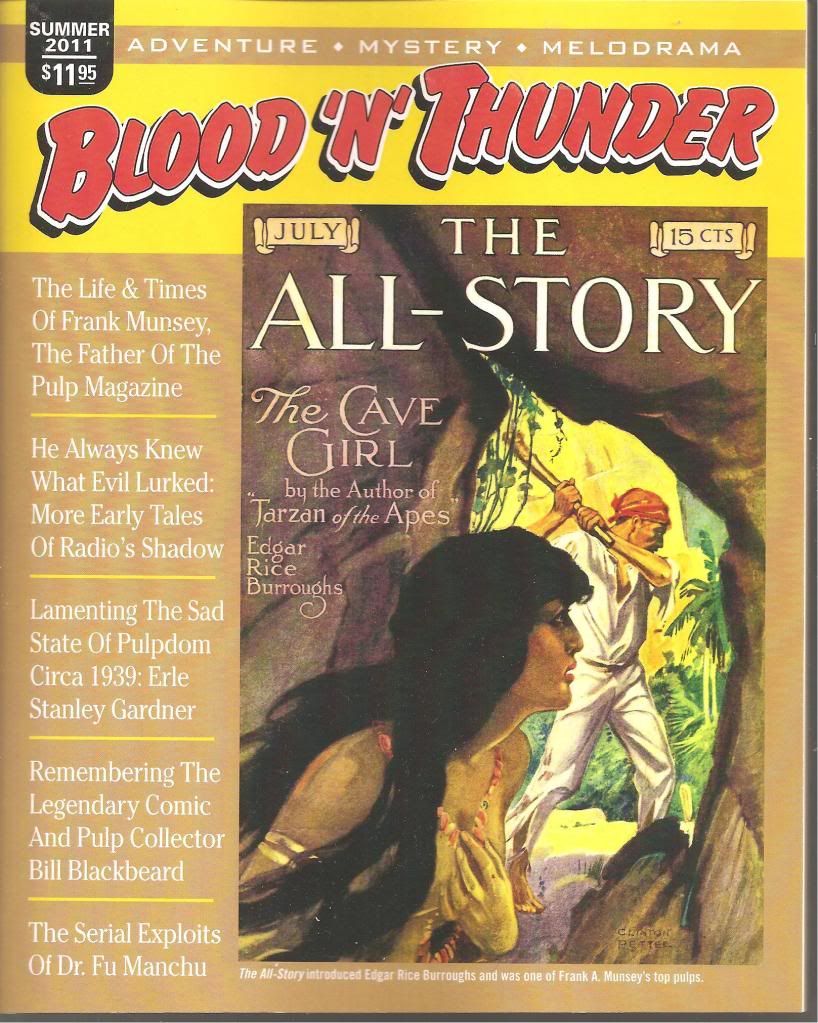
     While I am waiting for some primary sources to arrive, in relation to an article I am working on concerning dime novels, I just wanted to put up a notice that my expanded (and, in my opinion, much better) biography of Frank Andrew Munsey, founder of the Argosy and creator of the pulp magazine itself, is in print, in the latest issue (Summer 2011) of the pulp journal Blood'n'Thunder, now available at Amazon.

     I am very proud of how it turned out, and the images provided by editor Ed Hulse make the piece ten times better than it would have been otherwise. I am in his debt regarding those, as well as the chance to contribute to his journal in the first place. My article is only one of many, and is dwarfed by the other outstanding pieces in the issue, such as: the second installment of Martin Grams Jr.'s study of The Shadow's radio show; Mark Trost's investigation into pulp heroes that transitioned into the four-color world of comics; and an examination of the 1930s serial, The Drums of Fu Manchu, by Daniel J, Neyer; and many others of superior quality to my contribution. Nonetheless, I recommend the issue for all of those interested in pulp and pulp-related history; if you happen to read my article, and enjoy it, please let me know what you thought. Your input, suggestions, and most of all, your readership is sincerely appreciated. Thank you.

Photobucket


Wednesday, August 3, 2011

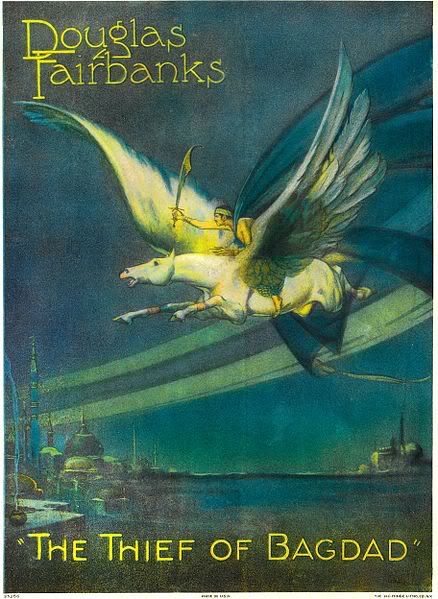
The Thief of Bagdad - 1924 - Douglas Fairbanks

     PulpFest 2011 was this past weekend, and while I was unable to attend this time around, I am glad to hear all of the positive reports that have been written the last few days regarding it. It sounds that sales of pulps were good, panels were well-attended, and there were more people attending than in years' prior - all good signs for pulp fandom.

     I wanted to post something this time regarding not pulps directly, but rather early cinema. I had seen the 1924, Douglas Fairbanks classic The Thief of Bagdad years earlier, and despite a good deal of the stereotypes and political incorrectness that appears, I still recognized it as an important part of Hollywood, and overall cinematic, history. However, it was only recently that I realized the film's connection to the pulps.


Photobucket

     The film's screenplay was written by Alexander Nicholayevitch Romanoff (12 May, 1881 - 12 May, 1945), better known as Achmed Abdullah, a pulp writer who is responsible for dozens upon dozens of stories, voluminous tales that (most often) took place in the "mystic" Orient (generically encompassing anywhere between India, to China to miscellaneous Oceania locales).  Appearing in many of the most popular of twentieth century pulp titles, Abdullah's tales were a reflection of his own life, sensationalized accounts inspired by his travels throughout both the Orient and the Occident, and featured glimpses into the languages, religions, customs and cultures he had encountered on those journeys. In addition to his pulp stories, Abdullah penned many novels and books, as well as screenplays for other productions, such as Chang - A Drama of the Wilderness (1927), and the play The Honorable Mr. Wong, which was eventually remade into a film starring the legendary Edward G. Robinson (as a Chinese tong-man in "yellow-face"), and retitled The Hatchet-Man (1932).

     Of special note in this film is also one of the earlier screen appearances of Hollywood legend Anna May Wong, one of my favorite actresses and whose biography, Anna May Wong - From Laundryman's Daughter to Hollywood Legend by Graham Russell Hodges, I can not recommend highly enough as providing interesting insight into both her life, as well as the history of early Hollywood and Sino-American relations.


Video courtesy of The Internet Archives - http://www.archive.org

Saturday, July 23, 2011

Original Fandom - Golden Age Green Lantern

A good friend of mine sent this to me the other day, and I just wanted to post it here as well, as it speaks a great deal about the history of fandom, comic books, and just the simple idea that kids, at one point, were able to have fun without "Xstations," "PlayBoxes," "I-Everythings," and whatever manner of de-individualizing nonsense is all the rage these days. And, before I am accused of being an "old fogey;"  I am 28 years old - then again, maybe that is an old fogey, these days.


Image courtesy of Awesome Robo.
http://www.awesome-robo.com/2011/06/green-lantern-makes-for-amazing-costume.html

Sunday, July 10, 2011

Dime Novels and Story Papers III - A Brief Commentary

            The story papers, often combined in recent writings with other works of the period to form the somewhat problematic and generic term of "Dime Novels," actually have a history all their own, quite separate, but still related to, the history of dime novels. The story papers are also intertwined with the history of the pulp magazines, as the first all-fiction pulp magazine, Frank Munsey's The Argosy, began life as a story paper of juvenile fiction, first published in December of 1882. One of the most prolific pulp publishers, the Street and Smith Company, also has its origins in the story paper era. Depending on how one looks at the situation, whether the dime novel or the story paper came first could be debated; some will say that the story paper, as it reached its heights of popularity in the late nineteenth century, only did so due to the popularity of dime novels. Others will contend that the early story papers, and the newspaper fiction columns that preceded them, helped “popularize literature,” and paved the way for the growth of dime novels following the release of Beadle and Adam's first dime novel, Malaeska, The Indian Wife of the White Hunter (by Ann S. Stephens) in 1860. I have heard both arguments, from those who favor one medium over the other. Whatever the case, the popularity these two mediums enjoyed is unquestionable, and many aspiring publishing-magnates realized this fact. In Munsey's case, The Golden Argosy's title was partly borrowed from another juvenile fiction paper popular at the time, Golden Days, which featured the works of many writers who would later work for Munsey, such as Edward S. Ellis and Horatio Alger, Jr.
Photobucket

            Aside from the name of his paper, Munsey was inspired by the monetary success of other story papers selling quite well back in his home state of Maine, such as The People's Literary Companion and Vickery's Fireside Visitor. There was a rise in literacy that began during the mid-nineteenth century, thanks to both the spread of public education, as well as the Post Office Act of 1852; this Act allowed for the publisher to ship reading material for two cents, as opposed to the previous six cents the recipient was responsible for paying upon delivery. This change in postal rates has been called “the greatest boon to mass education ever conceived” – more people were reading, and finding pleasure in doing so, than at any other time in history previously. Beginning with serialized stories printed in newspapers such as The New York Ledger (beginning in 1856), helmed by Richard Bonner (“The Barnum of the publishing industry”), popular fiction eventually began to sell on its own, and became an industry outside of the newspapers. 
            Two youths who were avid readers of Bonner’s Ledger were Francis Scott Street and Francis Shubael Smith, business manager and editor, respectively, on a small-circulation newspaper, The Sunday Dispatch. The owner of the paper, one Amos Williams (who, by all accounts, held a strong, personal connection to the two) eventually sold The Dispatch, now re-titled The New York Weekly Dispatch, to Street and Smith; on the tenth of October, 1857, Smith’s serial “The Vestmaker’s Apprentice; Or, The Vampryes of Society” appeared in the Weekly, and circulation immediately shot upward for what had been, until that time, a struggling publication. Smith continued writing short stories and serials for the paper, while Street’s business acumen aided in the Weekly’s rise; foreseeing the economic panic that gripped the nation in 1857, he (smartly) began to focus on the selling of  papers at newsstands, as opposed to relying on subscriptions. This move kept The New York Weekly (Dispatch having been dropped within a year of Smith’s first story) not only afloat during the panic, but actually prosperous. One of the early progenitors of the story papers that would flood the market in the succeeding years had been born. Other publications and periodicals followed, with the Street and Smith Company growing to become a powerful force in the American publishing industry throughout most of the twentieth century. It was their example, in addition to those of such “captains of industry” as Andrew Carnegie and J. Pierpont Morgan, that inspired a young Frank Munsey to seek his fortunes outside of the confines of a small, telegraph office in Maine. A little over twelve years after emulating Street and Smith’s success with the story papers, Munsey would (directly or indirectly – it depends on one’s personal opinion of Munsey) kill off the medium, or at the very least, speed its demise, with the introduction of the pulp magazine.
Photobucket


            The story papers did not necessarily replace dime novels as popular literature, or vice versa, such as comic books would do to pulps in the following century; rather, one complimented the other, both featuring a secondary route to inexpensive, working-class literature. In many cases, some of the same stories, or variations of which, appeared in both mediums. Detective Nick Carter, collegiate hero Frank Merriwell, and a host of others appeared in both dime novels and story papers. Dime novels eventually died out, only to be followed by the story papers; by the 1920s, story papers still circulated, but these were very few in number, the last remnants that existed before becoming overrun by the pulp magazine, which was able to offer hundreds of pages of sensationalized fiction.
            As has been said, works such as The Nugget Library and The Golden Argosy were the precursors to pulp magazines, and later comic books. While having different audiences to a large degree, the place of inexpensive, working-class literature was filled by the dime novels and papers, to be succeeded by the pulps and then comic books. As was the case with the pulp magazines later, the dime novels and story papers of the nineteenth and early twentieth centuries were derided as garbage by overseers of the "hoi polloi," who warned that they corrupted youths' minds. Voices, of which the likes of Frederic Wertham and others would be an echo of decades later, claimed that the fantasy found within those pages created a lawless and lustful generation of young Americans. As would also be the case years later, the authors of such stories were called hacks, and their understanding of literary standards repeatedly called into question. As dime novel historian Edmund Pearson pointed out in 1922, however, such attacks probably had less to do with concerns over morality and more to do with book publisher's threatened sales. In speaking of a recently-donated collection of dime novels to the New York Public Library, Pearson writes:
            It is perpetually useful for each generation to see how much unnecessary anguish has  been suffered in the past over things which were really harmless . . .They were never immoral; on the contrary, they reeked of morality. . . Indeed, there is reason to believe that many of the superstitious beliefs about the harmfulness of the dime novel were eagerly fostered and circulated by agents of the "respectable" publishing houses, to whom  any books which sold for ten cents was grossly immoral, for that very reason.

Anyone who actually reads dime novels and story papers will see exactly what Pearson is speaking of; the level of traditional, Puritanical morality evident in the majority of such works is extremely high. Consider, for example, Street and Smith’s understanding of what was fit to print in their papers:

            They [other periodicals and story papers of the day] will discover, when it is too late,  perhaps, that the people of the United States will not sustain papers whose editors gather up all the filth from the gutters and dens of infamy to make their columns “spicy.” A paper, to obtain a permanent circulation, must inculcate good morals and pay some regard to decency.

While this does not discount the presence of other attributes understood to be unacceptable today (such as instances of nativism, or misogyny), it does provide significant argument against the notion that the popular literature was poisoning youngsters' minds with delusions of sin, vice, promiscuity, and other similar accusations.

            On a slight, opinionated aside, it is interesting to note the progression of popular literature, from the dime novels up through the comic books and then….to what? Comic books still exist, but that is really a niche audience, that does not grow a great deal no matter what marketing gimmicks movie studios try to use in promoting comic book-based films. As far as predominant, inexpensive literature; what has, or could, replace the comic book? In my mind, nothing really, brought on by my opinion that the majority of Americans do not actually read (the pseudo-intellectual hipster sitting around sipping a mocha with a stack of books on his or her table at Barnes and Noble does not count as “reading”); also, the closest contender (today's paperback novels) are not nearly as inexpensive as comics and pulps were, by comparisons that take inflation into account. I can not imagine there will ever be anything that will fill the void left, first by the story papers and dime novels, and later by the pulps, in terms of actual, physical works, but also in the diversity of stories, characters, and ideas that flourished in the pages of those mediums. The creativity of those days is lacking today, and I sincerely have my doubts concerning whether it will, or even can, be reclaimed.


            Ron Goulart, Cheap Thrills - An Informal History of the Pulp Magazines (New York: Arlington House, 1972).
    
            Edmund Pearson, Dime Novels; Or, Following an Old Trail in Popular Literature (Port Washington: Kennikat Press, 1968 [Little, Brown and Company, 1929]).
   
            Edmund Pearson, "Beadle's Dime Novels," The Independent, August 5, 1922, 37.    

            Quentin Reynolds, The Fiction Factory, or from Pulp Row to Quality Street – The Story of 100 Years of Publishing at Street and Smith (New York: Random House, 1955).

Thank you to the Galactic Central webpage cover gallery for the Golden Argosy image.